
How to Assess Balance & Mobility
Do you struggle with balance or mobility, or feel like your lower body is weak?
Try performing a 30-second Sit-to-Stand Test.
The Sit-to-Stand Test is a simple assessment that measures your strength and mobility and can give you a better indication of lower-body weakness and fall risk.

How to Assess Your Balance
The Sit-to-Stand test is an easy way to assess balance at home and only requires a sturdy chair and a timer to complete.
It’s important to note that the Sit-to-Stand Test is only an assessment tool. If you find that you perform poorly on the test or struggle with balance and mobility, it’s important to reach out to your doctor or a Physical or Occupational Therapist for further evaluation.
Performing a Sit-to-Stand Test
Before starting the test, make sure you’re wearing comfortable clothing and footwear that provides a stable base of support.
When selecting a chair to use for the test, make sure it’s armless and has a seat height that allows your feet to rest flat on the ground.
To perform the test:
-
- Start by sitting with your back straight against the backrest of the chair, your feet flat on the ground, and your hands resting on your thighs or folded across your chest.
- Stand up as quickly as possible without using your hands for support, hold for a second, and sit back down. When sitting, make sure your movement is controlled and you’re not falling back into the chair.
- Count sitting to standing as one repetition.
- Repeat the sitting-to-standing motion as many times as you can in 30 seconds and record your results.
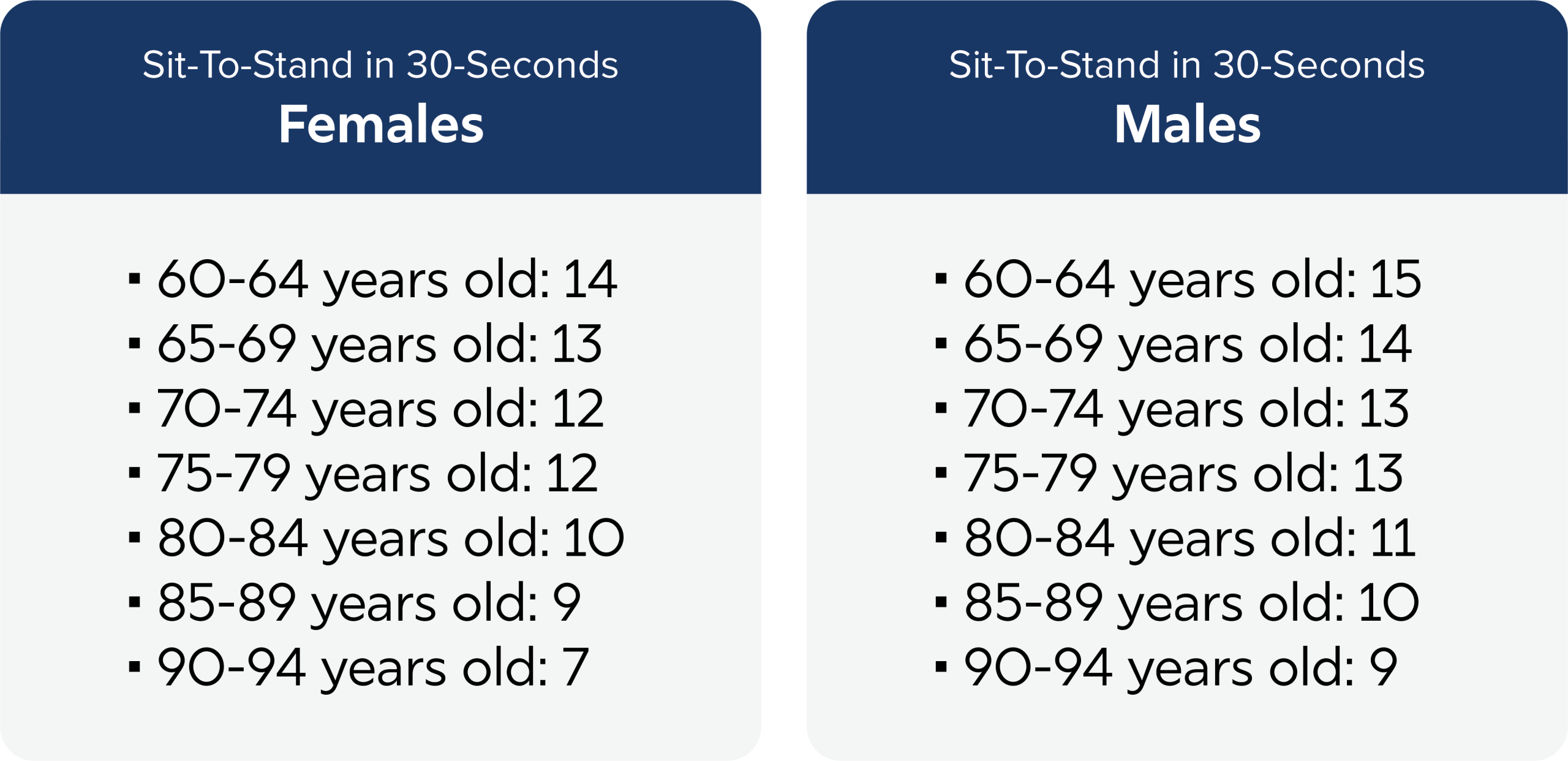
Below is the average number of sit-to-stands you should be able to complete by age and gender. If you’re below the number for your age and gender, you may be at a greater risk of falling.
If you’re looking for more ways to improve your balance, check out our free replay of our Wellness Series class, Find Your Balance, led by Physical Therapist Chris Ponichtera, PT DPT FAFS, and Director of Occupational Therapy Jill Katz, MS OTR/L.
You’ll learn exercises and strategies to reduce your risk of falls and move with greater ease. You can also access our free white paper, which includes tips and exercises to help you build your balance.
Build Your Balance Whitepaper | Printer-friendly version here.

Need help improving your balance or mobility?
Treatment is covered by insurance, no referral is needed to start, and with flexible appointments available, you can find a time that works with your schedule.
Call 716-458-1990 or click below to get started.